

Charles L. Kelly
Major
57th Medical Detachment (Helicopter Ambulance)
April 10, 1925 – July 1, 1964
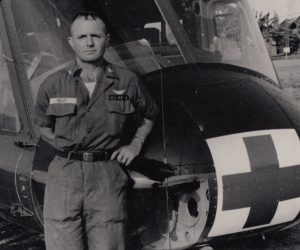
Maj. Charles L. Kelly in Vietnam, early 1964. National Archives
When I have your wounded
Maj. Charles L. Kelly was a helicopter pilot and commander of the 57th Medical Detachment (Helicopter Ambulance) in Vietnam. He popularized the radio callsign “Dust Off” for medical evacuations used throughout the war. He proved the effectiveness of helicopters dedicated solely for battlefield medical evacuations. Kelly’s service left a legacy of courage, selflessness and excellence. His impact on promoting bravery among pilots to help injured Soldiers is still seen today.
Charles Livingston Kelly was born on April 10, 1925, in Wadley, Ga. He was the oldest of three with two younger brothers. When he was only six years old, his father died. While Kelly was attending Sylvania High School in Sylvania, Ga., he decided to drop out to enlist in the Army. He lied about his age and enlisted in the Army at 15 years old. In October 1944 he was severely injured while serving in Aachen, Germany. After World War II, Kelly returned to Sylvania High School and graduated in 1947 as class president. Kelly married Jessie Hillis and had three children. Kelly then obtained a Bachelor of Science from Georgia Teachers College (now Georgia Southern University’s Peabody’s College of Education and Human Development). He also obtained a Master of Arts in geology from George Peabody College (now Vanderbilt University) in Nashville, Tenn. Kelly briefly taught until he decided to return to military service.
On Oct. 19, 1951, Kelly accepted a commission into the Army Medical Corps and was active duty on Nov. 10, 1951. For the next three months, he attended the Medical Field Service School. He then was a medical assistant at Fort Campbell, Ky. for two years. Kelly then completed Army Aviation School and the Army Cargo Helicopter Pilot Course. He received his Army Aviator wings on Oct. 2, 1954. Both achievements were at Fort Sill, Okla. Over the next ten years, he completed aviation training, medical training, and held various leadership positions. He took command of the 57th Medical Detachment (Helicopter Ambulance) in January 1964, his final assignment.
Kelly is credited with proving the need for helicopter medical evacuation in modern combat. At the time, battlefield evacuation by helicopter and the use of helicopters in combat was a new concept. His unit’s rapid response time saved numerous lives that would have otherwise been lost because of lack of medical care. The 57th contributed to the concept of the “golden hour,” a medical concept first described in the early 1960s by Dr. R Adams Cowley. This means survival chances increase if traumatic injuries are treated within the first hour, as Cowley witnessed in Europe after World War II and during his work in Baltimore. The swift helicopter evacuations proved this concept.
Kelly’s emphasis on courage, proper and frequent training, and the importance he placed on each mission contributed to the rapid development of helicopter medical evacuation. For example, the number of evacuated Soldiers increased from 193 in February 1964 to 416 in March. His unit’s effectiveness led to the establishment of the air ambulance platoon. The Air Ambulance Platoon was part of the first air mobile division in the U.S. Army, the 1st Cavalry Division. Kelly’s work also eventually led to the establishment of Army medical companies. Today, the Army Air Ambulance unit usually operates the UH-60L Black Hawk, the HH-60M, or the UH-72 Lakota helicopters. These helicopters are staffed by highly specialized pilots, nurses, and flight medics. They also feature advanced medical equipment.
Kelly’s unit coined the callsign “Dust Off” for medical evacuation requests, as the helicopters kicked up clouds of dirt when landing and taking off. This callsign remained for the rest of the war. He passed his unwavering belief of service onto his fellow and future DUSTOFF pilots. One example is his increase in the number of night-time missions. The enemy often attacked at night, utilizing the cover of darkness. Previously, Army officials declared night missions were too dangerous. Even though the risk of crashes and accidents increased significantly at night, Kelly reasoned that injured Soldiers still needed care. Kelly also fought for the maintenance of dedicated medical helicopter units. The 57th was so dedicated to the mission that many pilots intentionally logged fewer hours to ensure that they were not forced to stop flying once reaching their 140-hour monthly limit.
Kelly made a significant impact not only on his unit, but throughout the Army. One nine-day period in April 1964 cemented Kelly’s legacy. On April 2, 1964, Kelly and his crew rushed to a DUSTOFF call of a helicopter so badly damaged by enemy fire that it was forced to land in enemy territory. As the helicopter was making the emergency landing, Kelly and his crew arrived. He disregarded his own safety and landed in the middle of the enemy under heavy fire. On April 9, 1964, while searching for a downed Republic of Vietnam Air Force T-28, Kelly and his crew responded to a separate DUSTOFF call from a fellow Army helicopter crew. Kelly rescued the crew, taking on heavy enemy fire from all sides. They also destroyed the remnants of the helicopter to prevent useful parts from falling into enemy hands. On April 11, 1964, Kelly received a call of two critically wounded South Vietnamese soldiers. As nighttime approached, Kelly chose to rescue the wounded men. He hovered for 20 minutes in a dangerously small, inclined landing zone on the side of the mountain and amidst a dense jungle canopy. Despite hazardous weather, approaching darkness, and constant enemy fire, Kelly evacuated the men promptly, saving them from certain death. For these actions, he was awarded the Distinguished Flying Cross with two bronze oak leaf clusters.
Kelly never wavered in his commitment to his fellow Soldier. On June 19, 1964, he chose to attempt a second landing under extreme enemy fire to rescue wounded Soldiers after the first landing failed. His helicopter’s fuel tank was hit, but he made it back to base with minutes to spare. On July 1, 1964, Kelly ignored warnings against his personal safety when landing in an especially hostile landing zone. His final radio transmission dismissing these warnings became the motto of the 57th Medical Detachment (Helicopter Ambulance): “When I have your wounded.” Shortly after speaking these words, Kelly was shot through the heart and killed in action.
Kelly’s coolness under fire, skilled flying, and commitment to helping the wounded gained him the respect of all those around him. His selfless death to enemy fire during an especially dangerous mission ensured that his memory lived on. His three Distinguished Flying Crosses, Distinguished Service Cross, and Silver Star awards indicate his courage. He even inspired future Medal of Honor recipients. Maj. Patrick H. Brady flew missions with Kelly and returned to Vietnam for a second tour when he was awarded the Medal of Honor. CWO Michael J. Novosel was in a different unit but was equally inspired by Kelly’s legacy. Today, air ambulance units maintain this selfless commitment to rescuing the wounded. Kelly is memorialized by Charles Kelly Boulevard in Adams County, Colorado, and a marker stands outside the University of Colorado Anschutz Medical Campus (formerly the Fitzsimmons Army Medical Center). “DUSTOFF” remains the callsign for medical evacuations in the Army today.
Chris Horan
Historic Research Intern | Adams Center for Military History, Virginia Military Institute
Sources
Dorland, Peter, and James Nanney. Dust Off: Army Aeromedical Evacuation in Vietnam. Washington, D.C.: U.S. Army Center of Military History, 2008.
DUSTOFF Association. “Home.” Accessed June 9, 2026. https://dustoff.org/.
Find a Grave. “Maj. Charles Livingston Kelly (1925–1964).” Memorial no. 100708999. Accessed June 29, 2026. https://www.findagrave.com/memorial/100708999/charles_livingston-kelly.
Hall of Valor Project. “Charles Livingston Kelly.” Military Times. Accessed June 9, 2026. https://valor.militarytimes.com/recipient/recipient-4761/.
The Historical Marker Database. “Charles Kelly Boulevard: A War Memorial.” Accessed June 29, 2026. https://www.hmdb.org/m.asp?m=96555.
“Matching Tradition: ‘Dustoff’ Lifts Patient Care to Higher Level.” U.S. Army. October 24, 2013. Accessed June 29, 2026. https://www.army.mil/article/112011/matching_tradition_dustoff_lifts_patient_care_to_higher_level.
O’Dowd, Niall. “Combat Kelly: Helicopter Pilot Killed in Vietnam War in 1964.” IrishCentral, August 2, 2022. Accessed June 29, 2026. https://www.irishcentral.com/opinion/others/combat-kelly-helicopter-pilot-vietnam-war.
“The Sign Not Left to Dust.” U.S. Army. August 13, 2024. Accessed June 29, 2026. https://www.army.mil/article/278876/the_sign_not_left_to_dust.
Traces of War. “Memorial Major Charles L. Kelly, MSC – Aurora.” Accessed June 29, 2026. https://www.tracesofwar.com/sights/139607/Memorial-Major-Charles-L-Kelly-MSC.htm.
Veteran Tributes. “Charles L. Kelly.” Accessed June 9, 2026. http://www.veterantributes.org/TributeDetail.php?recordID=769.
Wellspring NorthBay Health. “The Golden Hour.” Accessed June 9, 2026. https://wellspring.northbay.org/the-golden-hour/.
Additional Resources
Congressional Medal of Honor Society. “Patrick Henry Brady.” Accessed June 9, 2026. https://www.cmohs.org/recipients/patrick-h-brady.
Congressional Medal of Honor Society. “Michael J. Novosel.” Accessed June 9, 2026. https://www.cmohs.org/recipients/michael-j-novosel.
DUSTOFF Association. “General History and Importance Today.” Accessed June 9, 2026. https://dustoff.org/.