

The rise of industry and mass production in the 19th and early 20th centuries fostered the birth of global superpowers. Population rapidly increased, cities grew, agricultural efficiency increased, and economic capability exploded. The military was one of the most significant areas during this period. Technological innovation exponentially increased. Mass-produced, efficient, and deadly weapons rapidly emerged. The UH-1 Huey surfaced in 1956, just 53 years after the Wright Brothers flew the first successful airplane. The adoption and widespread use of helicopters during the Vietnam War forever changed warfare. It vastly expanded capabilities in troop transport, medical care, and air support. It also demonstrates the Army’s ability to adapt to an ever-changing environment.
The nature of fighting in Vietnam posed a unique challenge. The United States faced a dangerous counter-insurgency campaign, where a large portion of the enemy force were guerilla fighters who did not wear conventional uniforms and relied on surprise attacks. The enemy was highly elusive and dedicated. The dense jungle environment proved difficult physically and operationally. South Vietnam consists of coastal plains, fertile deltas, and mountainous rainforests rising between 6,000 to 8,000 feet. An intense rainy monsoon season and extremely high heat and humidity created an immensely difficult combat environment. Therefore, the Bell UH-1 Huey became not only an iconic symbol of the war, but a significant technological innovation and advantage.
Early History and the Huey
The first use of the helicopter in combat was during World War II in Burma. The Sikorsky YR-4B was used to rescue four British soldiers that crash-landed. In Korea, this concept was expanded upon, although it was most extensively used for evacuating battlefield casualties. The helicopters used in the Korean War, however, paled in comparison to the helicopters of the Vietnam War. The H-13 Sioux helicopter of the Korean War used a much weaker piston engine. The Bell UH-1 Huey of Vietnam used the revolutionary turbine engine, the first helicopter of its kind. This allowed for much greater capabilities in power generation, maximum distance, and maximum weight. These engines made the helicopter lighter, faster, easier to control, and more reliable. It was a truly revolutionary step forward in aviation technology.
In the early 1960s, United States Army General Hamilton Howze was a prominent advocate for helicopters. He believed transporting mobile assault troops into combat offered a unique advantage. Units such as the 82nd Airborne Division (All American) and 101st Airborne Division (Screaming Eagles) relied on fixed wing airplanes to make rapid parachute deployments into hostile territory during World War II. Howze argued that an even more rapid deployment was possible through more mobile and versatile helicopters. Therefore, the Army created the experimental 11th Air Assault Division to test these theories. The Army found that combat helicopter squadrons were very effective at rapidly deploying troops. Terrain was largely overcome. This advantage would prove extremely useful during the Vietnam War and future conflicts.
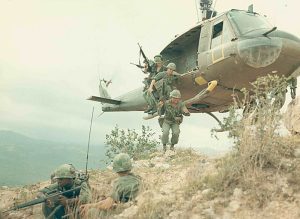
U.S. Soldiers jump from a hovering Bell UH-1D Huey helicopter near Khe Sanh, South Vietnam, during Operation Pegasus, April 1968. U.S. Army
Army officials also realized the advantage that armed helicopters could bring. By October 1962, Huey UH-1B gunships supported Army and Marine transport helicopters. They featured .30-caliber machine guns and 2.75-inch rocket pods. During a helicopter insertion, gunships proved a necessity. These gunships used rockets and machine gun fire to suppress suspected enemy positions while the troop transports inserted their Soldiers. Some Hueys even had smoke generators that deployed thick clouds of smoke to create concealment for the deploying Soldiers. Simultaneously, door gunners fired the M60 machine gun. Often, Soldiers would jump from a hovering helicopter in especially hostile zones. With the support of gunships, helicopters could deploy 300 to 1,000 Soldiers in minutes. By the end of 1964, there were already 300 model A and B Hueys in service in Vietnam.
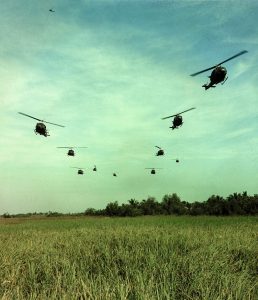
Operation “Rang Dong.” A column of UH-1D helicopters prepare to disembark members of Company C, 3rd Battalion, 7th Infantry, 199th Light Infantry Brigade, for a combat assault. Nov. 21, 1967. U.S. Army
In 1965, the UH-1D Huey entered service. This came after combat experience revealed necessary areas of improvement. The UH-1D featured an improved and stronger engine. This performed much better at higher altitudes and humidities. By early 1967, Bell engineers achieved the final upgrade of the Huey: the UH-1H. The UH-1H was stronger, more efficient, and had more cargo space. At peak troop levels during the Vietnam War in 1970, there were more than 3,900 helicopters in service. Two thirds of these helicopters were Hueys. Thirty-four other nations have used Huey helicopters, and there are still hundreds in service today. The Consolidated B-24 Liberator, a heavy bomber used during World War II, is the only military aircraft in American history that outnumbers the Huey in number produced. The Huey is also one of the few aircraft used in service for more than 30 years. This was due to continued innovation and adaptation over an 11-year period.
The First Attack Helicopter: The AH-1 Cobra
Another example of the Army’s innovation is the development of the first attack helicopter. Initially, Lockheed won the long-term U.S. Army contract to build an attack helicopter, the AH-56 Cheyenne. The process of developing this advanced helicopter would take many years, however. Rather than starting from scratch and being forced to compete with other companies, Bell engineer Mike Folse led the effort in 1965 to adapt the Huey into a sleek, new attack helicopter. Using the same engine, transmission, and rotors as the Huey, Bell produced the AH-1 Cobra. While Lockheed won the contract in 1966, the first Cheyenne would not be ready for test flights until September 1967. However, the first Cobras arrived in Vietnam on Aug. 29, 1967. Technical issues encountered during testing, inter-branch rivalry over air support responsibilities with the Air Force, and the success of the Cobra in Vietnam resulted in the cancellation of the Cheyenne program in 1972.
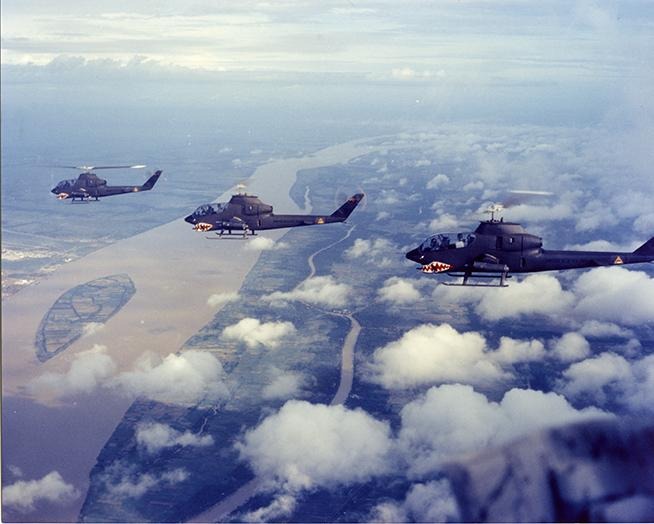
Three Cobra helicopters make up a Heavy Fire Team from Troop A, 7th Squadron, 1st Cavalry Regiment (Airmobile) over the Mekong River. Jim Sprinkle Collection, Vietnam Center and Sam Johnson Vietnam Archive, Texas Tech University
The AH-1 Cobra was lightweight, extremely fast, and loaded with firepower. It used 2.75-inch rocket pods, an electric-powered minigun, and grenade launchers. As many as 76 rockets could be fired from the Cobra’s rocket pods. Like Hueys, Cobra teams also featured two pilots. The main pilot operated from the rear cockpit and manned the rockets. The co-pilot sat in the front with a wider field of view and utilized the minigun and grenade launcher. Cobras flew missions with twice as much ammunition as Huey gunships. Therefore, they could engage the enemy at the target for three times longer. They also reached their objectives in half the time of Huey gunships. Between the arrival of the Cobra to Vietnam and 1973, 1,100 of these aircraft were produced, 270 were destroyed, and 231 pilots were killed or went missing in action. There were more than 1 million flight hours logged from the cockpit of a Cobra. It was retired from service in 1999.
Hughes OH-6A Observation Helicopter: “the Loach”
The AH-1 Cobra often paired with Hughes OH-6A observation helicopters. OH-6A helicopters were called Loaches and arrived in Vietnam by December 1967. The Loach was designed for speed: its main rotor was only 26 feet in diameter. It was extremely maneuverable and simply designed. They often flew only 10 feet over the treetops at 45 to 60 mph and on occasion used a minigun if installed by the unit. There were usually two pilots and occasionally a door gunner. The helicopter was so simple that there was no hydraulic system, and the electrical system was mainly for starting the engine. The aluminum body over a strong frame allowed pilots to survive most crashes. This was because the aluminum absorbed impacts and crumbled. The lightweight frame allowed for speed and maneuverability. This was crucial for low-level flying. However, it was ineffective at resisting enemy fire.
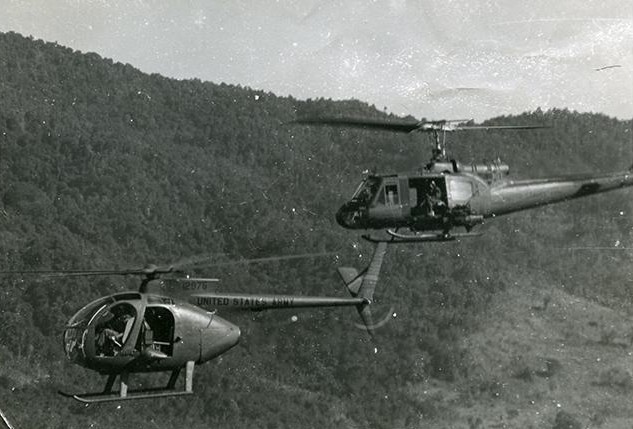
A Loach and Huey fly over Vietnam. Robert H. Nevins Collections, Vietnam Center and Sam Johnson Vietnam Archive, Texas Tech University
Hunter-Killer Teams
The pairing of these helicopters demonstrated yet another innovative adaptation by the Army. These pairs of Cobras and Loaches were called “Hunter-Killer Teams.” Due to the unconventional guerilla-warfare nature of fighting, the enemy relied on ambush tactics utilizing the concealment of the jungle. Low-flying Loaches essentially served as bait to the enemy. As the Loaches observed movement on the ground and reacted to enemy fire, Cobra helicopters flew at around 1,500 feet. Constant radio communication was crucial. Loach pilots often dropped smoke grenades to mark enemy positions. The Cobras then unloaded into enemy positions.
The main mission of these teams was to gather intelligence. Therefore, these teams flew missions every morning at dawn. They typically searched for enemy bunkers, encampments, trails, or any other sign of the enemy. Pilots could track recent enemy movements by trampled grass or even spot smoldering cigarette butts. Teams were denoted by color. Pink teams indicated one Loach and one Cobra. Purple teams indicated one Loach and two Cobras. On occasion these Hunter-Killer teams worked in coordination with Blue teams. Blue teams were four Hueys on standby in case of the need for an infantry deployment or rescue.
The rapid development of these helicopters indicates yet another element of Army innovation. The development of combat doctrine based on adaptation was key. In an unconventional and unpredictable war, the effectiveness of a particular strategy cannot be known until it is implemented. For example, the difficult terrain of Vietnam did not reliably allow fixed-wing air support to be available. An aerial base could be too far to readily provide air support. Additionally, fixed wing support generally fell under the responsibility of the Air Force. At times, Soldiers could have to wait upwards of 30 minutes. In a war of ambushes, Soldiers could not afford to wait. Use of attack helicopters provided simpler communication and more versatile response. The birth of the attack helicopter proved crucial in addressing this problem.
DUSTOFF: Medical Helicopters in Vietnam
One of the most crucial innovative adaptations of the Vietnam War was the use of helicopters for medical evacuations. In Korea, the H-13 Sioux successfully completed many evacuations from the battlefield. However, it had very limited cargo space, was underpowered, and unfit for Vietnam. The arrival of the first Hueys in Vietnam marked a shift to widespread use of helicopters in combat. By the end of the war, more than 900,000 allied military personnel and Vietnamese civilians were evacuated by air ambulances. Numerous lives were saved that would have otherwise ended without prompt medical care.
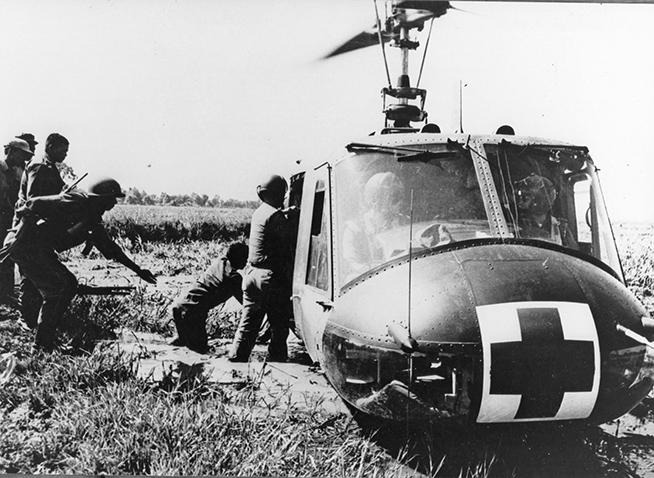
UH-1 MEDEVAC helicopter in Vietnam. U.S. Army Aviation Museum Volunteer Archivists Collection, Vietnam Center and Sam Johnson Vietnam Archive, Texas Tech University
The first medical units arrived in Vietnam in 1962. One of these units was the 57th Medical Detachment (Helicopter Ambulance). As it was early in the war, the 57th faced numerous difficulties. United States bases of operations were few and remote. This limited the reach of these medical crews. Furthermore, the 57th was the only unit in Vietnam with UH-1s Hueys at this time. Obtaining proper replacement parts was both difficult and time consuming. The unit was required to submit orders to the U.S. Army on Okinawa. Generally, only 75% of orders could be fulfilled. As more advisors and medical personnel arrived in Vietnam, access to equipment improved. In 1964, Maj. Charles L. Kelly proved the effectiveness of medical helicopters in rescuing the wounded. These were commonly called Dustoff missions by their radio callsign.
Although Kelly was only in command of the 57th Medical Detachment for six months before his death, he proved the necessity of Dustoff pilots. He also established a high standard of Dustoff pilots. Previously, pilots were advised not to engage in dangerous nighttime flights. Instead, Kelly encouraged these missions and increased their frequency. Furthermore, the 57th sought out Dustoff missions. Previously, pilots were on standby at base. Under Kelly’s leadership, pilots sought out rescue missions and often flew around their area of operations in case Soldiers needed assistance. Peter Dorland and James Nanney’s in their publication Dust Off: Army Aeromedical Evacuation in Vietnam concisely described Kelly. “When Kelly flew such a mission he rarely let bad weather, darkness, or the enemy stop him from completing it. He fought his way to the casualties and brought them out” (36). On July 1, 1964, Kelly was killed in action by enemy small arms fire. A bullet struck him in the heart during one of his many daring rescue missions. Kelly’s heroic sacrifice set the precedent early in the war for Dustoff pilots across units. His final words, “When I have your wounded,” inspired numerous future Dustoff pilots. Despite numerous warnings against his personal safety, he still decided to rescue the wounded.
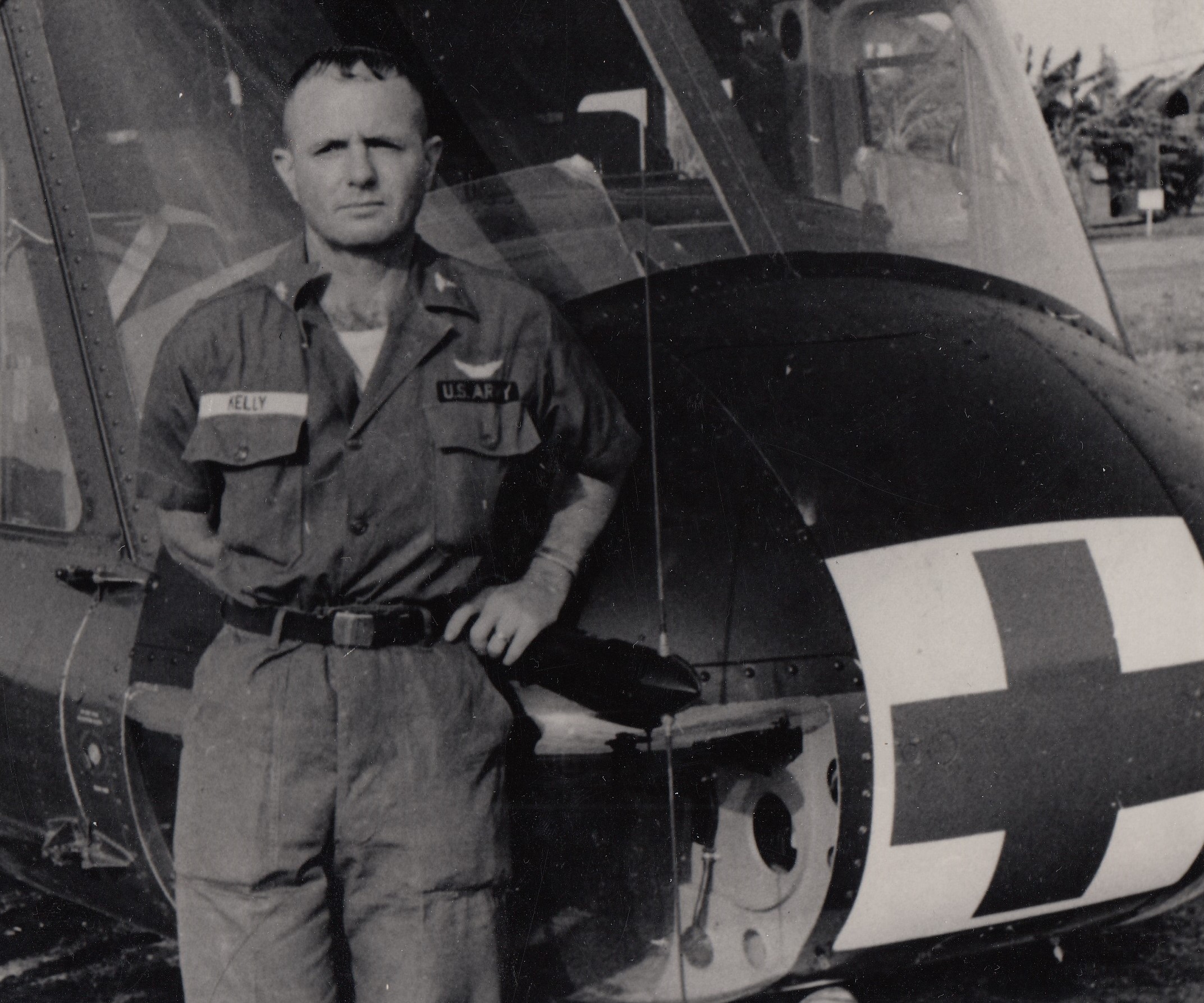
Maj. Charles L. Kelly in Vietnam, early 1964. National Archives
Within the medical community, further innovations occurred. Organizationally, the stellar performance of the 57th Medical Detachment (Helicopter Ambulance) led to the creation of the Air Ambulance Platoon. The Air Ambulance Platoon was a medical platoon attached to a combat assault division instead of a medical brigade. This was due to yet another innovative step by the Army: the creation of the 1st Cavalry Division (Airmobile). The 1st Cavalry had four and a half times the number of aircraft and half the number of ground vehicles. It also had nearly 1,000 aviators and nearly 2,000 mechanics. Within the Air Ambulance Platoon, there were 12 Hueys. The 1st Cavalry and the Air Ambulance Platoon proved their effectiveness as well as the tremendous advantage that helicopters provided on the battlefield at the three-day Battle of Ia Drang Valley. Nine hundred American Soldiers faced 2,600 North Vietnamese at Landing Zones X-ray and Albany. Despite these overwhelming odds, the 1st Cavalry won the battle. The U.S. casualties were 234 dead and 235 wounded. The North Vietnamese suffered an estimated 3,561 deaths. Even when facing overwhelming odds, the courage and skill of the 1st Cavalry Division Soldiers, pilots, crewmen, and medical personnel ensured victory. Gunship support, rapid troop insertions, and prompt medical evacuations proved the effectiveness of this new aerial unit. The Army also created other medical units and medical air ambulance companies.
Between 1965-70, the Army fine-tuned the methods of medical evacuation. They saved hundreds of thousands of Soldiers, civilians, and even enemy combatants at times. The Army also developed a training program for the South Vietnamese as U.S. involvement in Vietnam gradually lessened. They even created evacuation tools specially tailored to overcome the jungle environment, such as the personnel rescue hoist and the semi-rigid litter. Throughout this perfection of evacuation methods, numerous stories of bravery and selflessness emerged. Two of these stories were Medals of Honor for Dustoff pilots. Maj. Patrick H. Brady single-handedly evacuated 51 wounded Soldiers in a single day. Heavy enemy fire caused him to fly three different aircraft throughout the day. CWO Michael J. Novosel evacuated 29 wounded Army of the Republic of Vietnam (ARVN) soldiers. He also was wounded during the mission and flew 11 hours that day. Bravery, skill, selflessness, and technological innovation combined to change the nature of U.S. Army warfare forever. The Bell UH-1 Huey represents a massive technological innovation as well as a turning point in Army combat doctrine.
Chris Horan
Historic Research Intern | Adams Center for Military History, Virginia Military Institute
Sources
Janda, Lance. “The Battle of Ia Drang Valley: Military History and Science: Research Starters.” EBSCO. Accessed June 15, 2026. https://www.ebsco.com/research-starters/military-history-and-science/battle-ia-drang-valley.
“Bell UH-1H Iroquois ‘Huey’ Smokey III.” National Air and Space Museum. Accessed June 15, 2026. https://airandspace.si.edu/collection-objects/bell-uh-1h-iroquois-huey-smokey-iii/nasm_A19960005000.
Dorland, Peter, and James Nanney. Dust Off: Army Aeromedical Evacuation in Vietnam. U.S. Army Center of Military History. Accessed June 15, 2026. https://history.army.mil/portals/143/Images/Publications/catalog/90-28-1.pdf.
DUSTOFF Association. “Home.” DUSTOFF. May 13, 2026. https://dustoff.org/.
“‘Dust Off’ and the Power of Perseverance.” Hektoen International. Accessed June 15, 2026. https://hekint.org/2017/01/22/dust-off-and-the-power-of-perseverance/.
“First Combat Helicopter.” History. Accessed June 29, 2026. https://www.history.com/videos/first-combat-helicopter.
“First Flight of the Huey – October 20, 1956.” National Wildfire Coordinating Group. Accessed June 15, 2026. https://www.nwcg.gov/6mfs/day-in-history/first-flight-of-the-huey-october-20th-1956.
Joiner, Stephen. “Birth of the Cobra.” Smithsonian Magazine, Aug. 1, 2017. https://www.smithsonianmag.com/air-space-magazine/13_aug2017-birth-of-the-cobra-180963930/.
Lepore, Herbert P. “The Coming of Age: The Role of the Helicopter in the Vietnam War.” Army History, no. 29 (1994): 29–36. http://www.jstor.org/stable/26304086.
Porter, Donald. “In Vietnam, These Helicopter Scouts Saw Combat Up Close.” Smithsonian Magazine, Sept. 1, 2017. https://www.smithsonianmag.com/air-space-magazine/snakes-loaches-180964341/.
“The Road Not Taken: The U.S. Army’s AH-56 Cheyenne Attack Helicopter.” The National Interest. Accessed July 2, 2026. https://nationalinterest.org/blog/buzz/the-road-not-taken-the-us-armys-ah-56-cheyenne-attack-helicopter.
Further Reading
Congressional Medal of Honor Society. “Patrick Henry Brady.” Accessed Nov. 5, 2026. https://www.cmohs.org/recipients/patrick-h-brady.
Congressional Medal of Honor Society. “Michael J. Novosel.” Accessed Nov. 5, 2026. https://www.cmohs.org/recipients/michael-j-novosel.
“Radio Communication Between Helicopter Pilots in Heavy Combat.” YouTube video, 3:39. Posted by “War Archives,” January 15, 2015. Accessed Nov. 5, 2026. https://www.youtube.com/watch?v=u19f7_jdyBw.
“Vietnam War Timeline.” History. Last modified August 23, 2021. Accessed Nov. 5, 2026. https://www.history.com/articles/vietnam-war-timeline.
“Weapons of the Vietnam War.” History video, 4:51. Accessed Nov. 5, 2026. https://www.history.com/videos/weapons-of-the-vietnam-war.