

Joseph Plumb Martin
Sergeant
Company of Sappers and Miners
November 21, 1760 – May 2, 1850
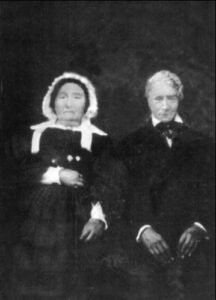
Painting of Joseph Plumb Marting and his wife, Lucy Clewly. 19th century. Public Domain
Sgt. Joseph Plumb Martin enlisted in the Continental Army during the Revolutionary War. Later in life, he published a memoir that reflects his personal experience of the war. Although unsuccessful at first, today it is popular with historians because it details his personal experiences of the War. Martin’s memoir provides important insight into understanding the life of a regular Soldier during the American Revolution.
Martin was born on Nov. 21, 1760, in Berkshire County, Massachusetts. He came from a family of farmers but moved to the city after his father became a pastor. At 7 years old, Martin went to live with his grandparents. He grew up during a time of rising tensions in the colonies. In his youth he preferred to keep to himself, but as the Revolution began Martin grew concerned. Even so, he was a year too young to enlist without his father’s consent. Still, the prospect of being a Soldier appealed to Martin and he never lost his drive to serve.
By the time Martin was old enough to enlist, he began to have reservations. Enlistments were a minimum of one year, which felt like too long of a commitment for many men like Martin. The Continental Army had a solution. They decided to reduce the enlistment period to six months. Martin enlisted in June 1776. While he waited in line, the crowds pushed in on him. In his memoir, he recalled how someone bumped into him causing him to make a mark on the enrollment paper. The recruiter said that mark could be his signature. Instead, Martin took the time to carefully write out his name, devoting himself to the cause. The next day, Martin informed his grandparents of his decision. Concerned for his safety, they prepared him before he left, giving him supplies and food. Martin, only 15 years old, had finally become a Soldier with the Connecticut Militia.
Martin played various roles and participated in some of the most important engagements of the Revolution. He began his experience in 1776 fighting with Gen. George Washington’s Army in New York at the Battles of Brooklyn and Kip’s Bay. Afterwards, he fought at the Battle of White Plains. These defeats taught the American forces valuable lessons which helped them win the war years later. At the conclusion of his enlistment in December 1776, Martin returned home to his grandparents.
On April 22, 1777, Martin reenlisted. He endured the bitter winter of 1777-78 at Valley Forge, Pennsylvania, where he remained until late June 1778. He served in the Battles of Germantown, Monmouth, and the Siege of Fort Mifflin. These experiences challenged the American Soldiers. Martin was no exception. The Soldiers were often freezing and starving, forcing Martin and his fellow Soldiers to forage for food. But help arrived from Friedrich von Steuben, a famous German drillmaster. He trained the men, including Martin, at Valley Forge. Martin must have been a fast learner because he transferred to the Continental Army’s light infantry. This unit was one of the most skilled in the Army. A year after Valley Forge, he spent the winter encamped in Morristown. The harsh conditions were too much for many Soldiers and Martin witnessed a mutiny in camp. Despite the setbacks, the Soldiers stayed resolved in their fight. Later, he transferred to the New Engineers Corps as part of the Sappers and Miners unit. Martin’s unit dug trenches for the American forces at the Siege of Yorktown. There, Martin participated in the seizure of Redoubt 10, led by Col. Alexander Hamilton. The work of Martin’s unit in Yorktown was crucial for the American victory. Martin endured the Revolution’s most crushing defeats and rough conditions. Finally, Martin, who had enlisted at the age of 15, celebrated the American victory at 22.
After the war, Martin continued to work as a servant for his community. He was a clerk and legislator in Prospect, Maine, where he remained for the rest of his life. Martin married Lucy Clewly on May 22, 1794, and they had five children. Over time, it became more difficult to provide for his family due to his age and deteriorating health. It was common for veterans to struggle to receive the benefits promised by Congress. After his service, he made several appeals for a pension. Finally, in April 1818, Martin received his pension.
Martin published his memoir in 1830 reflecting on his experiences of the Revolution. The original published title was “A Narrative of Some Adventures, Dangers, and Sufferings of a Revolutionary Soldier, Interspersed with Anecdotes of Incidents that Occurred Within His Observations.” The first edition was not popular, but over time it became an essential source for historians. Today it is commonly known as “Memoir of a Revolutionary Soldier.” In the memoir, Martin displays a sense of humor and a penchant to exaggerate. Even so, this work gives insight into daily life for enlisted Soldiers during the Revolution.
Martin died on May 2, 1850, at the age of 89. Like today, Soldiers fought in the war for various causes. Some fought for virtue, others for survival, and even for freedom. These reasons are not mutually exclusive. Yet, it is important to understand what life was like for the ordinary Soldier. Martin tells us the stories of the simple everyday man who became a Soldier and fought for the rights and independence of America. Martin made a name for himself in history. Even so, Martin’s gravestone is simple and only states, “A Soldier of the Revolution.”
Liam Smith
Historic Research Intern | Adams Center for Military History, Virginia Military Institute
Sources
“Joseph Plumb Martin.” National Park Service. Accessed June 2, 2025. https://www.nps.gov/people/joseph-plumb-martin.htm.
“Joseph Plumb Martin.” U.S. Army Center of Military History. Accessed June 2, 2025. https://history.army.mil/Revwar250/Profile/Joseph-Plumb-Martin/.
“Joseph Plumb Martin.” History. Accessed June 2, 2025. https://www.history.com/articles/joseph-plumb-martin.
“Joseph Plumb Martin: Voice of the Common American Soldier.” American Battlefield Trust. Accessed June 2, 2025. https://www.battlefields.org/learn/articles/joseph-plumb-martin
Martin, Joseph. Memoir of a Revolutionary War Soldier: The Narrative of Joseph Plumb Martin. Maine: Glazier, Masters & Co., 1830.
“Revolutionary War Pension and Bounty Land Warrant Application File W. 1629, for Joseph P Martin, Connecticut.” National Achieves Catalog. Accessed June 9, 2025. https://catalog.archives.gov/id/144148275?objectPanel=transcription.
Further Reading
“Selections from the Diary of Private Joseph Plumb Martin.” U.S. History. Accessed June 2, 2025. https://www.ushistory.org/march/other/martindiary.htm?srsltid=AfmBOopfRfE3oyrw4m4KKOehpjqHCqpPh6vaZQeZpA8ysAF9mwjejn4X.
“Meet Joseph Plumb Martin Performace.” Museum of the American Revolution. Accessed June 2, 2025. https://www.amrevmuseum.org/meet-joseph-plumb-martin-performance.