

Daniel McKie
Lieutenant
Hobson’s Virginia Regiment
May 6, 1759 – November 16, 1839
Lt. Daniel McKie fought in the Southern Theater of the Revolutionary War. McKie rose to the rank of lieutenant in Hobson’s Company of the 6th Virginia Regiment. He was at the Battle of Stono Ferry and Guilford Courthouse, where McKie selflessly carried and attended to his wounded superior, 1st Lt. Matthew Maury. Afterwards, McKie moved west; eventually residing in Mississippi along with his family. His life demonstrates the experiences of enlisted Soldiers in the Southern Theater.
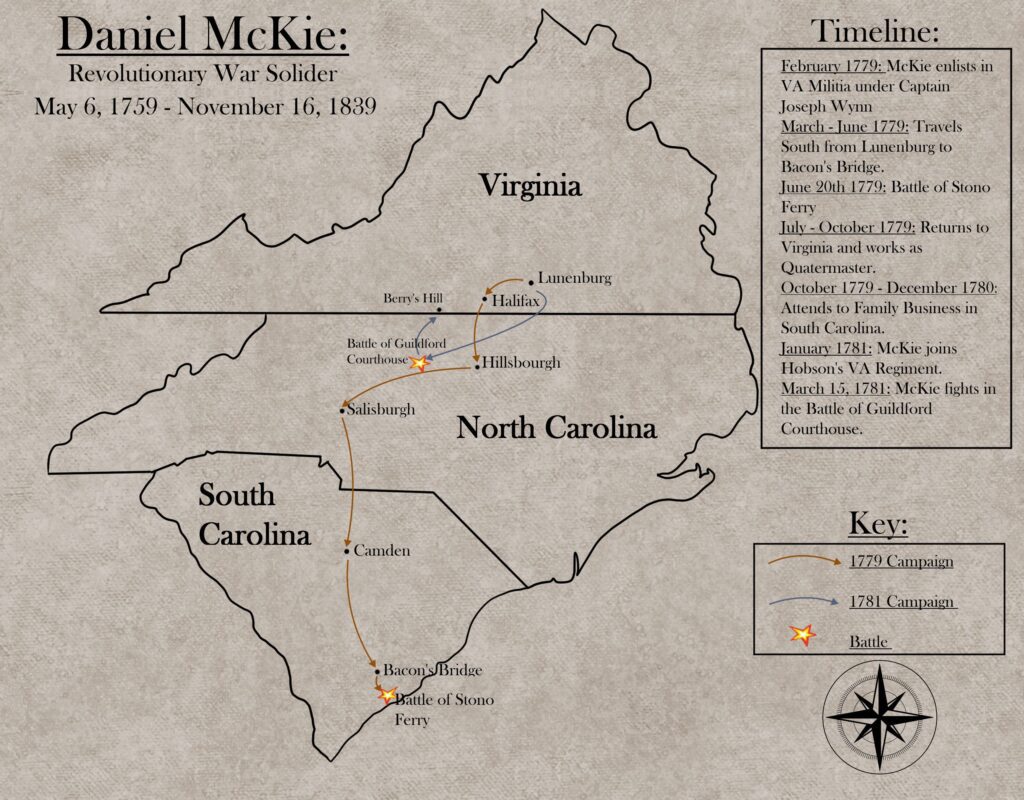
McKie was born May 6, 1759, in Lunenburg County, Virginia. Little is known about his early life before he joined the Virginia Militia in February 1779. McKie’s time with the militia took him throughout Virginia and down into South Carolina. Under the command of Capt. Joseph Wynn, he was promoted to sergeant and traveled to Halifax, Virginia. They joined Col. David Mason and the 15th Virginia Regiment on the way to Hillsborough, North Carolina where they met with Lt. Col. Lewis Burwell. They continued to journey south until meeting with Maj. Gen. Benjamin Lincoln near Bacon’s Bridge. Then, on June 20, 1779, the Americans, along with McKie, fought the British at the Battle of Stono Ferry.
When the British took Savannah, Brig. Gen. Augustine Prevost advanced to Charleston. However, when he became aware of a potential attack, he decided to retreat to John’s Island through the Stono River. Seizing the opportunity, Lincoln’s forces attacked. The British used Stono Ferry as a temporary fort to fend off the Americans. After a failed diversion, the Americans were forced to retreat. McKie and the Virginia regiments covered the retreat. After the Battle of Stono Ferry, many men returned to Virginia as their six-month enlistments expired. Even so, McKie stayed in the militia and served as quartermaster for an additional three months. He eventually left the militia and returned to his family in Virginia in December 1780.
Shortly after his return to Virginia, McKie decided to reenlist. He was granted furlough with expectations to be on standby if the Army needed him. He remained on standby for at least six months. When no orders came, McKie had to find other means to support himself. He eventually received orders but, preoccupied with other business matters, he hired a free Black man, Burwell Jones, as a substitute. Substitutes were not uncommon, especially in the later parts of the War. Typically, wealthy men were able to hire indentured servants, apprentices, or slaves to serve in their stead along with the promise of freedom. McKie was later informed that Jones had died during his service.
McKie decided to reenlist again in January 1781 in the 6th Virginia Regiment. He was promoted to second lieutenant under 1st Lt. Matthew Maury. The men combined with Maj. Gen. Nathanael Greene’s Army. Following the British loss at the Battle of Cowpens, British Lt. Gen. Charles, Lord Cornwallis relentlessly pursued the American forces. The two armies clashed at the Battle of Guilford Courthouse on March 15, 1781. While the British defeated the Americans, it was a Pyrrhic victory. The cost to the British was devastating and ultimately contributed to the American victory at Yorktown six months later.
During the battle, Maury was shot. McKie, seeing that Maury was injured, carried him away from danger. They eventually made their way to Perkin’s Iron Works, now known as Berry Hill, which was owned by Col. Peter Perkins and used as a hospital for Soldiers after the battle. McKie remained with Maury through the end of the Revolution when the Americans defeated the British on Oct. 19, 1781, at Yorktown. Maury recovered and returned home to Virginia but died two years later from his wound.
After the War, McKie traveled around the United States. In 1784, he moved to Georgia and lived there for four years before moving to South Carolina. He married Frances Herndon on March 18, 1794, in Newbery District, South Carolina. They had 13 children. In 1826, they moved to Tennessee where McKie claimed his pension. He later moved to Mississippi where he remained for the rest of his life. On Nov. 16, 1839, McKie died and was buried at Oxford Cemetery in Lafayette County, Mississippi.
After his death, his wife, Frances applied to receive his pension. They had married in South Carolina which did not keep marriage records at the time. Therefore, she was denied due to a lack of evidence. This experience was not uncommon for spouses after the Revolution. Some Soldiers even struggled to receive their own pensions due to a lack of documentation. Frances never remarried. She continued to fight for the pension but, despite her best efforts, was never approved. She survived him by 16 years until her death on Sept. 5, 1855.
The American Revolution created a new Nation. Today, many people romanticize the American Revolution, but it is important to remember the men like Daniel McKie and their families. McKie’s experience in the Revolution shows the experiences of regular Soldiers. Soldiers spent more time marching and at camp than in battle. During his first experience in the Militia, McKie marched for five months before seeing combat. The sacrifice of Soldiers like McKie made the country what it is today.
Liam Smith
Historic Research Intern | Adams Center for Military History, Virginia Military Institute
Sources
“Berry Hill, Danville vic., Pittsylvania County, Virginia.” Library of Congress. Accessed June 17, 2025. https://www.loc.gov/pictures/item/2017891117/.
Geist, Christopher. “A Common American Solider.” Colonial Williamsburg. Accessed June 17, 2025. https://research.colonialwilliamsburg.org/Foundation/journal/Autumn04/soldier.cfm.
“Guildford Courthouse.” American Battlefield Trust. Accessed June 17, 2025. https://www.battlefields.org/learn/revolutionary-war/battles/guilford-court-house.
“Revolutionary War Pension and Bounty Land Warrant Application File R. 6750, for Daniel Mc Kie, Virginia.” National Archives Catalog. Accessed June 17, 2025. https://catalog.archives.gov/id/144190617?objectPanel=transcription&objectPage=22.
Saunders, James. Early Settlers of Alabama. Reprint: Southern Historical Press, 1994.
“Stono Ferry.” American Battlefield Trust. Accessed June 17, 2025. https://www.battlefields.org/learn/revolutionary-war/battles/stono-ferry.