The Saratoga Campaign: June-October 1777

Under the British Cannon: Mount Defiance

Jefferys, Thomas, -1771. “A plan of the town and Fort of Carillon at Ticonderoga.” Map. London: Thos. Jefferys, [1758]. Norman B. Leventhal Map & Education Center, https://collections.leventhalmap.org/search/commonwealth:9s1618735 (accessed April 29, 2025).

Jefferys, Thomas, -1771. “A plan of the town and Fort of Carillon at Ticonderoga.” Map. London: Thos. Jefferys, [1758]. Norman B. Leventhal Map & Education Center, https://collections.leventhalmap.org/search/commonwealth:9s1618735 (accessed April 29, 2025).

Illustration of Mount Independence and nearby fortifications and waterbodies, courtesy of the Historic Sites Vermont government webpage.

Illustration of Mount Independence and nearby fortifications and waterbodies, courtesy of the Historic Sites Vermont government webpage.

Lionel Pincus and Princess Firyal Map Division, The New York Public Library. “A map of the county between Crown Point and Fort Edward” New York Public Library Digital Collections.

Lionel Pincus and Princess Firyal Map Division, The New York Public Library. “A map of the county between Crown Point and Fort Edward” New York Public Library Digital Collections.

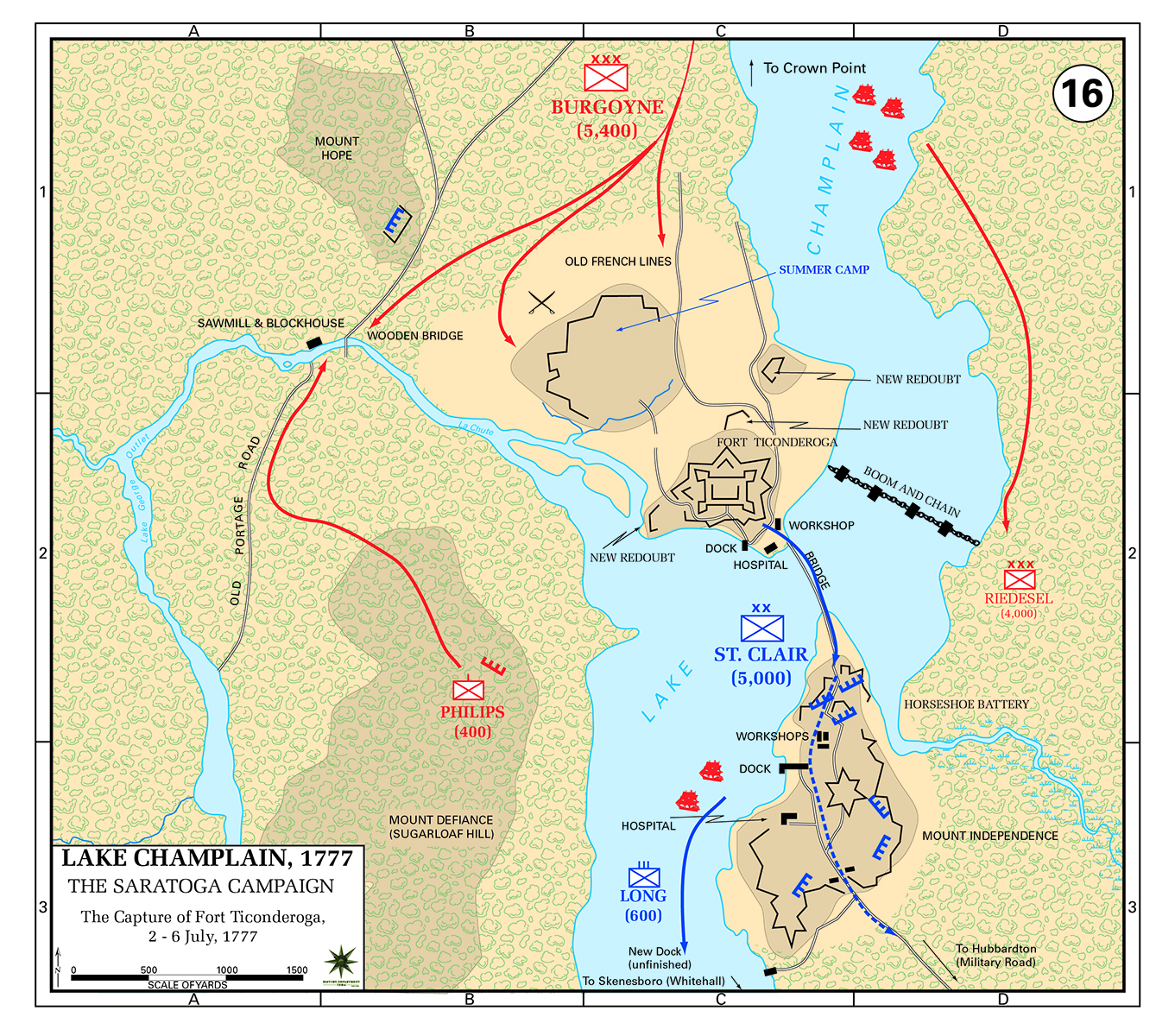
Lake Champlain, 1777. The Saratoga Campaign. Courtesy of the United States Military Academy.

Lake Champlain, 1777. The Saratoga Campaign. Courtesy of the United States Military Academy.

Mount Defiance (also called “Sugar Loaf”) towered over American fortifications at Ticonderoga and Mount Independence, as well as the footbridge across Lake Champlain that connected them. Inexplicably, Patriot commanders failed to fortify Mount Defiance. The British were not so careless; a reconnaissance party went out on 4 July 1777 to learn if artillery could be emplaced on the mountain. It could.

"[The] mountain had the entire command of the works and buildings both of Ticonderoga and Mount Independence, at a distance of about 1,400 yards from the latter, that the ground might be leveled so as to receive cannon, and the road to convey them, though difficult, might be made practicable in as little as twenty-four hours." Indeed, Twiss's reconnaissance led to the hasty retreat of all Patriot forces once American commanders observed their enemy building a road for artillery up the side of Mount Defiance."

1Lt. William Twiss
Sources
  • John Luzader. “Saratoga: A Military History of the Decisive Campaign of the American Revolution.” El Dorado Hills, CA: Savas Beatie, 2008, p. 163.