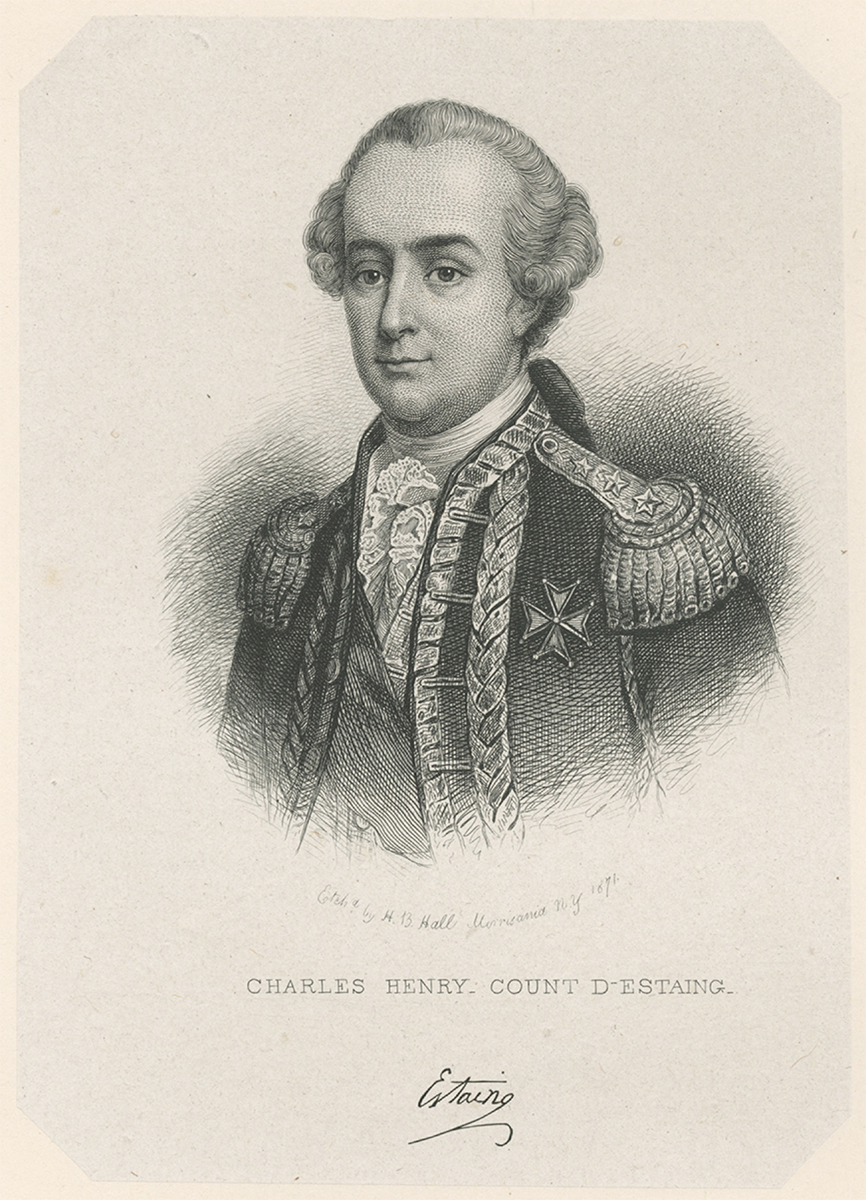
After arriving from the Caribbean with a fleet of forty-seven ships and around 4,000 French troops, the Count d’Estaing began landing those soldiers near the town on 12 September. The Vice-Admiral wrote down his initial impressions of the port city, garrisoned by some 2,500 British soldiers under the command of Maj. Gen. Augustine Prevost and supported by several small warships in the harbor.
"This city, situated on the southern bank of a river of the same name, appears to be built, with considerable regularity, of wood and brick, upon a uniform plain with a sandy soil, and is bounded on the south by a forest of thinly scattered pines, and on the north by the river Savannah. From east to west it has an extent of about six hundred toises [1200 yards], and in depth is considerably narrower. It did not seem to us that it possessed public buildings other than a temple [church] which occupies a central position. On the right and left are two swamps which render it inaccessible from those directions. The enemy, with a frigate carrying nine-pounder guns, and two galleys armed with pounder guns, stationed in the river at the western extremity of the city, had nothing to fear from the rear, or from the right and left."
Count d'Estaing
Sources
Jones, C. C. (1874). “The siege of Savannah: in 1779, as described in two contemporaneous journals of French officers in the fleet of Count d’Estaing.” Albany, N. Y.: J. Munsell, p. 19.