Savannah: September-October 1779

Count d’Estaing Describes the Assault

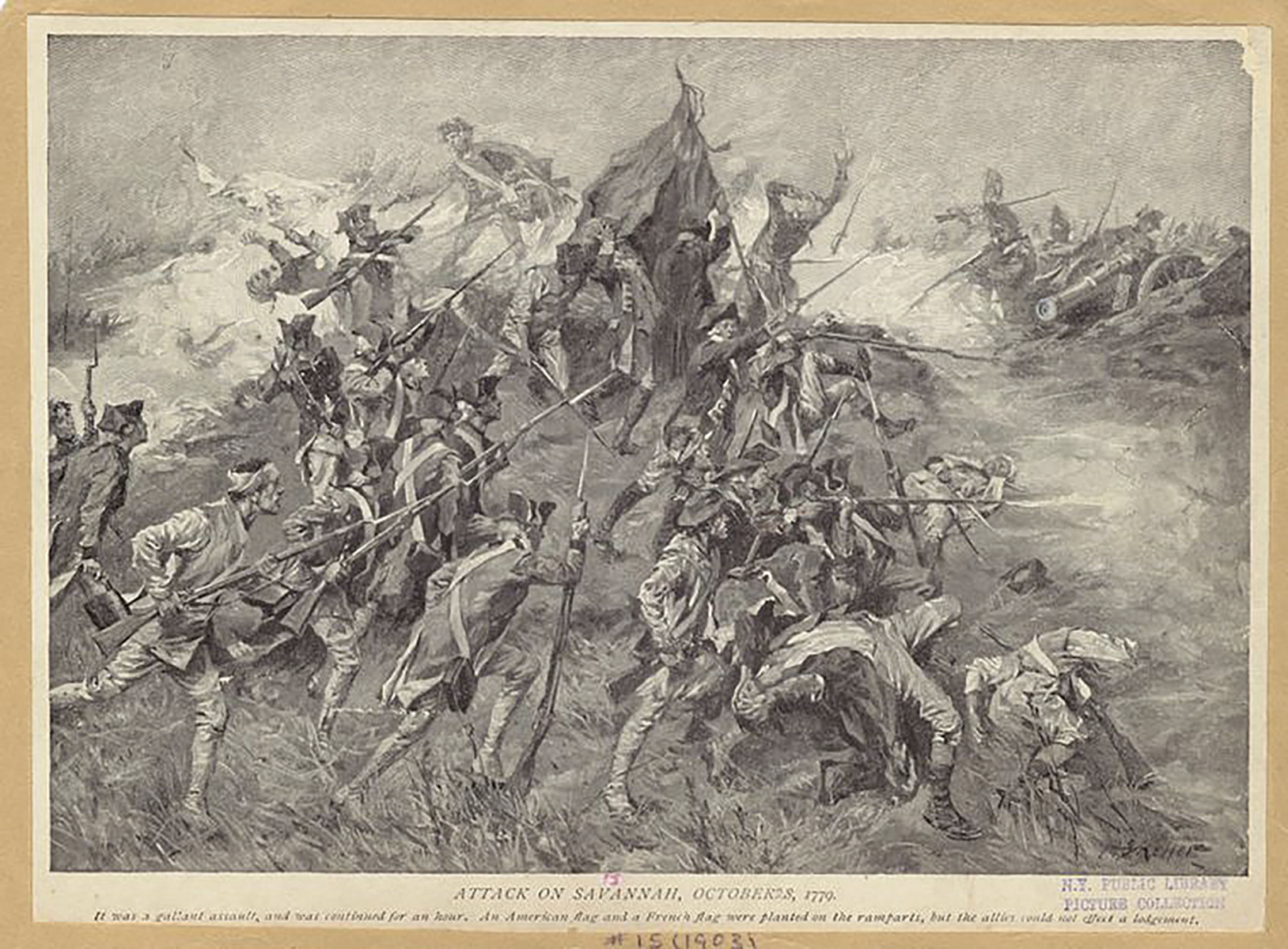
The Miriam and Ira D. Wallach Division of Art, Prints and Photographs: Picture Collection, The New York Public Library. “Attack on Savannah, October 8, 1779” New York Public Library Digital Collections.

The Miriam and Ira D. Wallach Division of Art, Prints and Photographs: Picture Collection, The New York Public Library. “Attack on Savannah, October 8, 1779” New York Public Library Digital Collections.

Savannah and Its Environs. [1779] Map. Library of Congress.

Savannah and Its Environs. [1779] Map. Library of Congress.

Taking of Savannah in De. [1778] Map. Library of Congress.

Taking of Savannah in De. [1778] Map. Library of Congress.

On the morning of 9 October 1779, the French and Americans launched a pair of diversionary attacks from the southeastern direction and sent their main force to assault the Spring Hill redoubt from the southwest.

"The action did not last longer than an hour; it was very violent. The enemy, almost as numerous as we, as we learned later, had gathered the greater part of their force around the Spring Hill redoubt; and it appears certain that two American deserters alerted them about the point of attack the day before. That no attention at all was paid to the two feint attacks from the trenches is even more reason for thinking so. The diversion that 500 Americans were to attempt on the enemy's left did not take place. They got lost. The two American galleys caused the attack from the river to fail. The first one, towed by longboats, dropped anchor. The second one was filled full of water, and M. le chevalier Durumain, ship's lieutenant who commanded this operation, could never get upriver as far as the city."

Count d’Estaing
Sources
  • Kennedy, Benjamin (ed.) “Muskets, Cannon Balls & Bombs: Nine Narratives of the Siege of Savannah in 1779. Madison, WI: Beehive Press, 1974, pp. 68-69.