Guilford Courthouse: 15 March 1781

The British Deploy for Battle at the Hoskins Farmstead

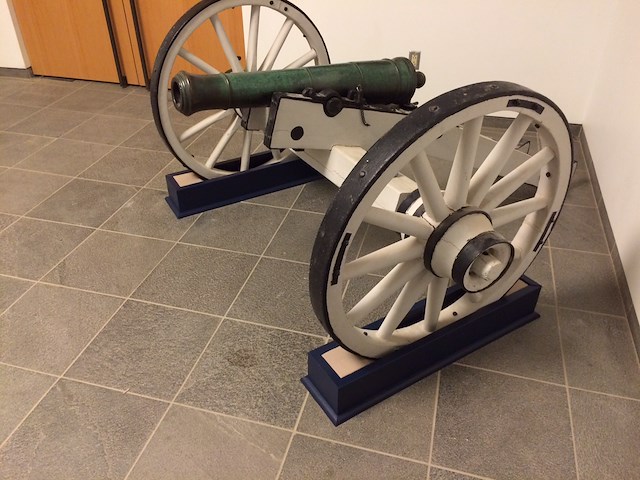
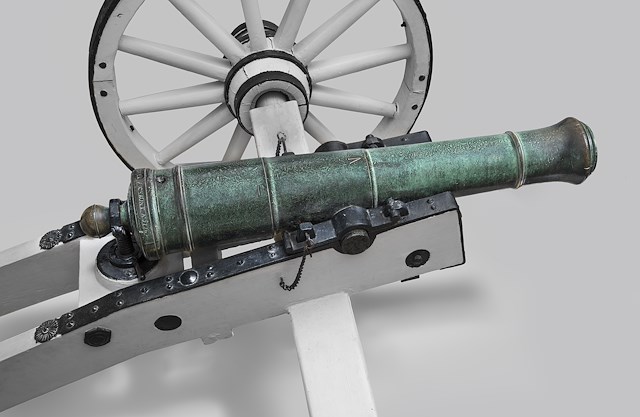
British bronze 3 pounder Congreve Pattern gun made by the Verbruggens at the Royal Arsenal, Woolwich. Object ID 1999.1179. Courtesy of the Fort Ticonderoga Museum Collection.

British bronze 3 pounder Congreve Pattern gun made by the Verbruggens at the Royal Arsenal, Woolwich. Object ID 1999.1179. Courtesy of the Fort Ticonderoga Museum Collection.

British bronze 3 pounder Congreve Pattern gun made by the Verbruggens at the Royal Arsenal, Woolwich. Object ID 1999.1179. Courtesy of the Fort Ticonderoga Museum Collection.

British bronze 3 pounder Congreve Pattern gun made by the Verbruggens at the Royal Arsenal, Woolwich. Object ID 1999.1179. Courtesy of the Fort Ticonderoga Museum Collection.

The Miriam and Ira D. Wallach Division of Art, Prints and Photographs: Picture Collection, The New York Public Library. “The battle-ground of Guildford Court House” New York Public Library Digital Collections.

The Miriam and Ira D. Wallach Division of Art, Prints and Photographs: Picture Collection, The New York Public Library. “The battle-ground of Guildford Court House” New York Public Library Digital Collections.

The British marched up from the west and began deploying in this general location, in a line of battle stretching north and south of New Garden (Salisbury) Road. The British 3 pounder gunners set up in the road facing east to provide covering fire against a line of enemy militia troops behind a fence line. as the British and Hessian troops deployed into line, an enemy cannon began firing grapeshot which caused few casualties but prompted Cornwallis’ officers to hurry their formation into line of battle. Cornwallis did not pause for reconaissance or to deploy light infantry skirmishers to precede the line of battle. He ordered his infantry regiments to start their movement to contact with the American militia line around 1300 hours (1 p.m.) on 15 March 1781, covered by the fire of their 3-pounder “grasshopper” cannons.

"As the front of the British column approached the open ground facing the American position, the enemy's six pounders opened from the road, and were immediately answered by the royal artillery. After Earl Cornwallis had consulted the guides...and viewed as much as he could the disposition of the militia, he desired Maj. Gen. Leslie to move to the right with the 71st and the regiment of Bose...for the attack on the enemy's left...Col. Webster was directed to form the 23d and 33d on the left of Leslie's division...The dragoons likewise could only move...in reserve till the infantry could penetrate through the woods...During these arrangements...the British artillery cannonaded the enemy's center with considerable effect...The troops were no sooner formed than they marched forward with steadiness and composure."

Lt. Col. Banastre Tarleton
Sources
  • Banastre Tarleton. “A History of the Campaigns of 1780-1.” London, 1787, pp. 272-273.