Guilford Courthouse: 15 March 1781

The Battle of Wetzell’s Mill

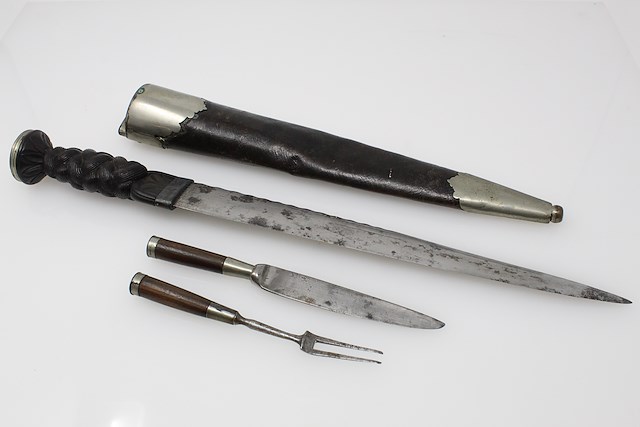
Scottish dirk with a scabbard which also holds a knife and fork. Object ID MC49:4. Courtesy of the Fort Ticonderoga Museum Collection.

Scottish dirk with a scabbard which also holds a knife and fork. Object ID MC49:4. Courtesy of the Fort Ticonderoga Museum Collection.

The Miriam and Ira D. Wallach Division of Art, Prints and Photographs: Print Collection, The New York Public Library. “Henry Lee, 1756-1818.” New York Public Library Digital Collections.

The Miriam and Ira D. Wallach Division of Art, Prints and Photographs: Print Collection, The New York Public Library. “Henry Lee, 1756-1818.” New York Public Library Digital Collections.

The Miriam and Ira D. Wallach Division of Art, Prints and Photographs: Print Collection, The New York Public Library. “Gen. Andrew Pickens.” New York Public Library Digital Collections.

The Miriam and Ira D. Wallach Division of Art, Prints and Photographs: Print Collection, The New York Public Library. “Gen. Andrew Pickens.” New York Public Library Digital Collections.

Greene began his counteroffensive by sending Lt. Col. Henry Lee’s cavalry and Brig. Gen. Andrew Pickens’s South Carolina militia to disrupt British recruiting and resupply efforts. On 25 February 1781, the American forces destroyed Lt. Col. John Pyle’s Loyalist unit during a one-sided battle, known as “Pyle’s Hacking Match.” The incident dried up the flow of supplies and Loyalist recruits to Cornwallis’ army. Cornwallis countered by attacking Col. Otho Holland Williams’ “flying army” of 700 Continentals and militia “posted carelessly at separate plantations for the convenience of subsisting” near Wetzell’s Mill on Reedy Fork Creek. Pickets spotted the British advance, forcing the scattered American units to withdraw hastily behind a militia rearguard. Williams avoided major losses, but General Pickens’ militia troops revolted due to their believe that Williams had carelessly left them unsupported during the skirmish. The two armies resumed their cat-and-mouse stalking game while Greene gathered reinforcements for the battle that was soon to come.

"When the Enemy first took their departure from the Dan they had every prospect of great reinforcements from the Tories of Carolina…if they were permitted to roam at large in the State that it would indubitably impress the idea of Conquest upon the Minds of the disaffected…and perhaps occasion those…to take an active and decisive part against us. I instantly determined...to advance into the state…It was necessary to convince the Carolinians that they were not conquered and by affording immediate protection…engage the continuance of their confidence and friendship."

Maj. Gen. Nathanael Greene to Governor Thomas Jefferson
Sources
  • Nathanael Greene. “The papers of General Nathanael Greene.” Vol. VII. Chapel Hill: Published for the Rhode Island Historical Society [by] University of North Carolina Press, 1976, pp. 419-420.