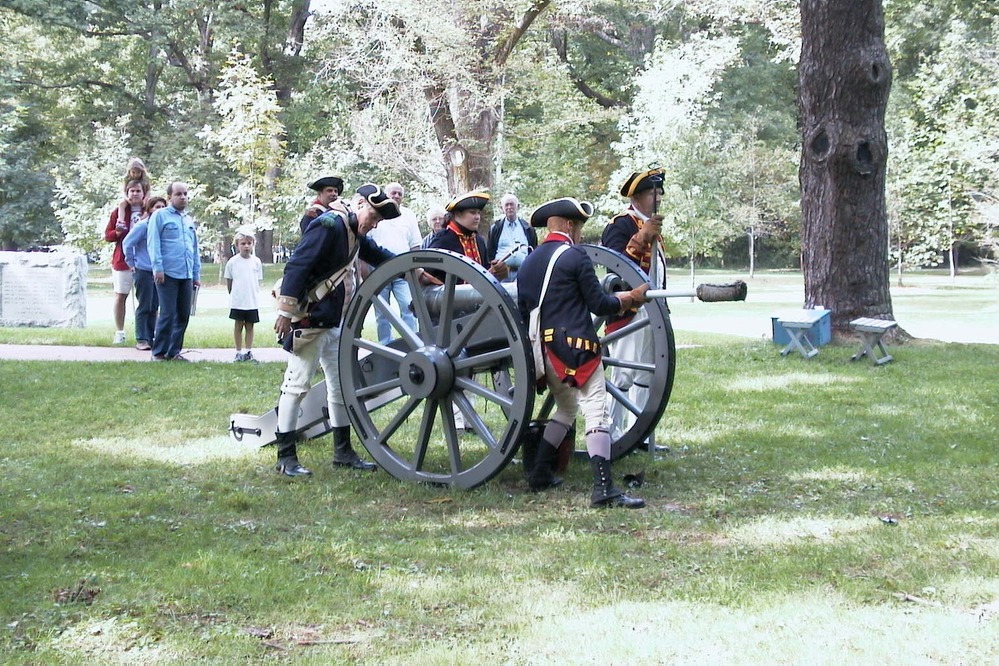
Facing the British behind a long fence were two brigades of 1,000 North Carolina short-service militiamen under Brig. Gen. Thomas Eaton and Brig. Gen. John Butler. The militia were armed with a wide variety of firearms, but few had muskets and bayonets or the training to use those weapons against British and German regular infantrymen. A Continental 6-pounder cannon in the road opened fire first, while most of the militiamen held their fire until the enemy line was within a killing distance. Skirmishers on either flank of the militia line attempted to pick off British officers with long-ranged fires before the North Carolinians fired a massed volley. British regulars under the command of Brig. Gen. James Webster closed on the right side of the American line, firing a single volley and then charging forward. On the American left flank, British troops under the command of Brig. Gen. Alexander Leslie advanced more slowly, giving Eaton’s brigade time to fire several devastating volleys, but the entire line of Patriot militia fled to the rear once the British got close enough to use their bayonets.
"Col. James Martin, commander of the Guilford County militia regiment noted: I was posted in the front line with scarce a complete captain's company commanded by Captain [Arthur] Forbis, a brave undaunted fellow. We were posted behind a fence and I told the men to sit down until the British who were advancing came near enough to shoot. When they came in about 200 yards I saw a British officer with a drawn sword driving up his men. I asked Capt. Forbis if he could take him down. He said he could for he had a good rifle and asked me if he should shoot then. I told him to let him in 50 yards and then take him down, which he did."
Col. James MartinJames Martin, Pension application, North Carolina State Records, Vol XXII, p. 148.