Charleston: March-May 1780

The Royal Navy Assault on Sullivan’s Island

The Miriam and Ira D. Wallach Division of Art, Prints and Photographs: Print Collection, The New York Public Library. “Gen. William Moultrie” New York Public Library Digital Collections.

The Miriam and Ira D. Wallach Division of Art, Prints and Photographs: Print Collection, The New York Public Library. “Gen. William Moultrie” New York Public Library Digital Collections.

The Miriam and Ira D. Wallach Division of Art, Prints and Photographs: Picture Collection, The New York Public Library. “The defence of Fort Sullivan, June 28, 1776” New York Public Library Digital Collections.

The Miriam and Ira D. Wallach Division of Art, Prints and Photographs: Picture Collection, The New York Public Library. “The defence of Fort Sullivan, June 28, 1776” New York Public Library Digital Collections.

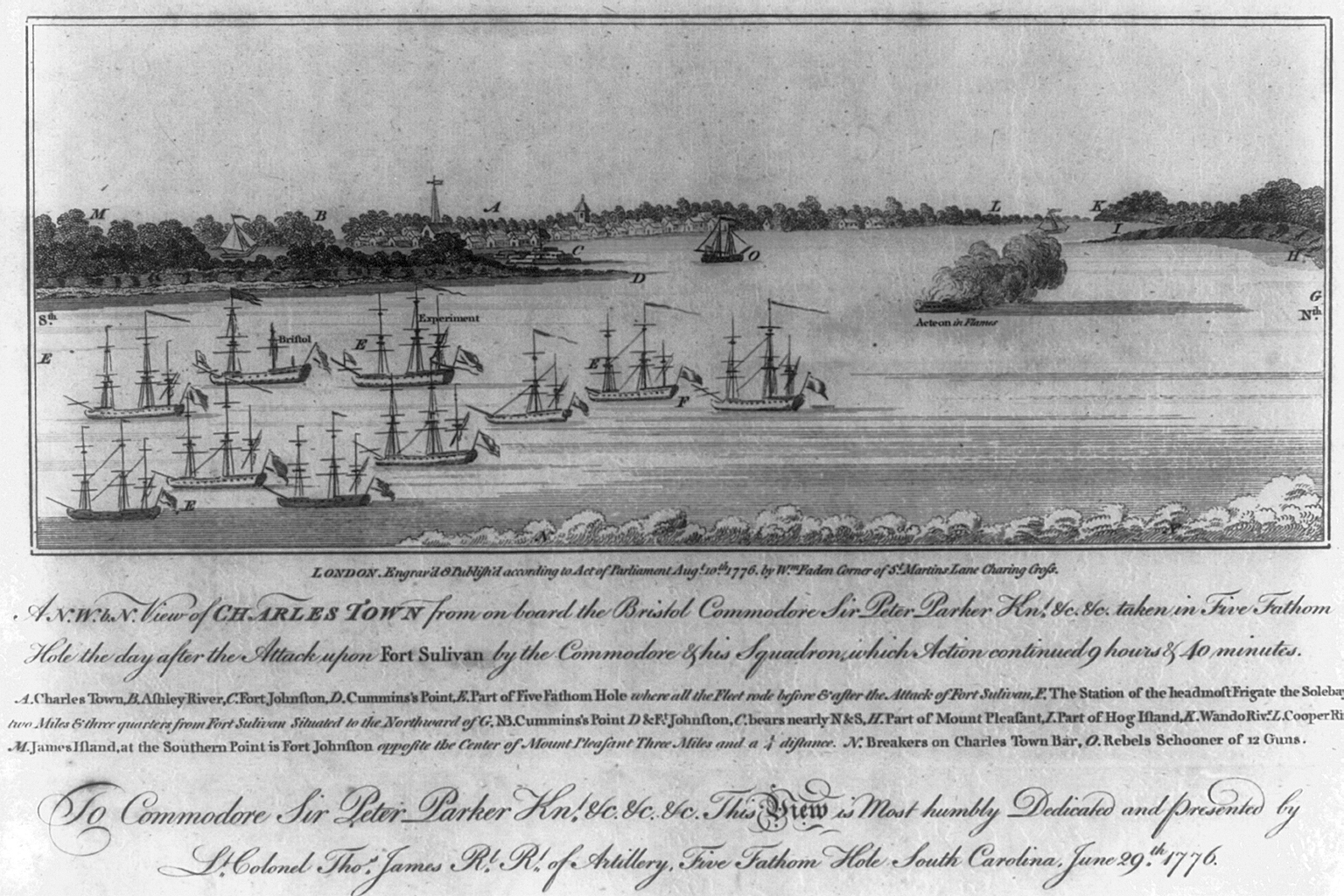
Faden, William, (engraver) A N.W.b.N. view of Charles Town from on board the Bristol . . . taken in Five Fathom Hole the day after the attack upon Fort Sullivan by the Commodore & his squadron, which action continued 9 hours & 40 minutes (London: Published According to Act of Parliament by Wm. Faden Corner of St. Martin’s Lane Charing Cross, 1776, Augt. 10th) Library of Congress.

Faden, William, (engraver) A N.W.b.N. view of Charles Town from on board the Bristol . . . taken in Five Fathom Hole the day after the attack upon Fort Sullivan by the Commodore & his squadron, which action continued 9 hours & 40 minutes (London: Published According to Act of Parliament by Wm. Faden Corner of St. Martin’s Lane Charing Cross, 1776, Augt. 10th) Library of Congress.

The Royal Navy ships arrived off Charleston in May 177. Based on scouting reports, Parker decided on an amphibious assault against an American fort overlooking the harbor, while Clinton would support by landing assault troops on the vulnerable east side of Sullivan’s Island. Parker assault on 25 June 1776 was marred by blunders, including the grounding of three frigates which lacked maps and competent harbor pilots. The naval bombardment proved to be ineffective as British cannon shot bounced harmlessly from the American fort’s palmetto log walls. Parker’s men cheered at midday when they saw the blue South Carolina liberty flag disappear, seemingly in surrender. The reappearance of the flag and a salvo of shot a few minutes later signified the American rebels were still in the fight. Parker, whose backside had been skimmed by a flying splinter, remained in the fight until sunset. The grounded HBMS Actaeon was scuttled, while every other ship had been riddled with American shot and shell-leaving behind 64 dead and 141 injured. To add insult to injury, the British watched an American boarding party steal the Actaeon’s ships bell after firing some of her guns at Parker’s flagship.

"By Order of Congress to Col. William Moultrie, or to the commanding officer, at Fort Johnson. Sir, You are hereby commanded, with the troops under your orders, by every military operation to endeavor to oppose the passage of any British naval armament that may attempt to pass Fort Johnson, until further orders by Congress, or the council of safety. William H. Drayton, President, Charlestown, Nov. 9th, 1775."

Letter from the Continental Congress
Sources
  • William Moultrie. “Memoirs of the American Revolution.” New York: David Longworth, 1802, p. 101.